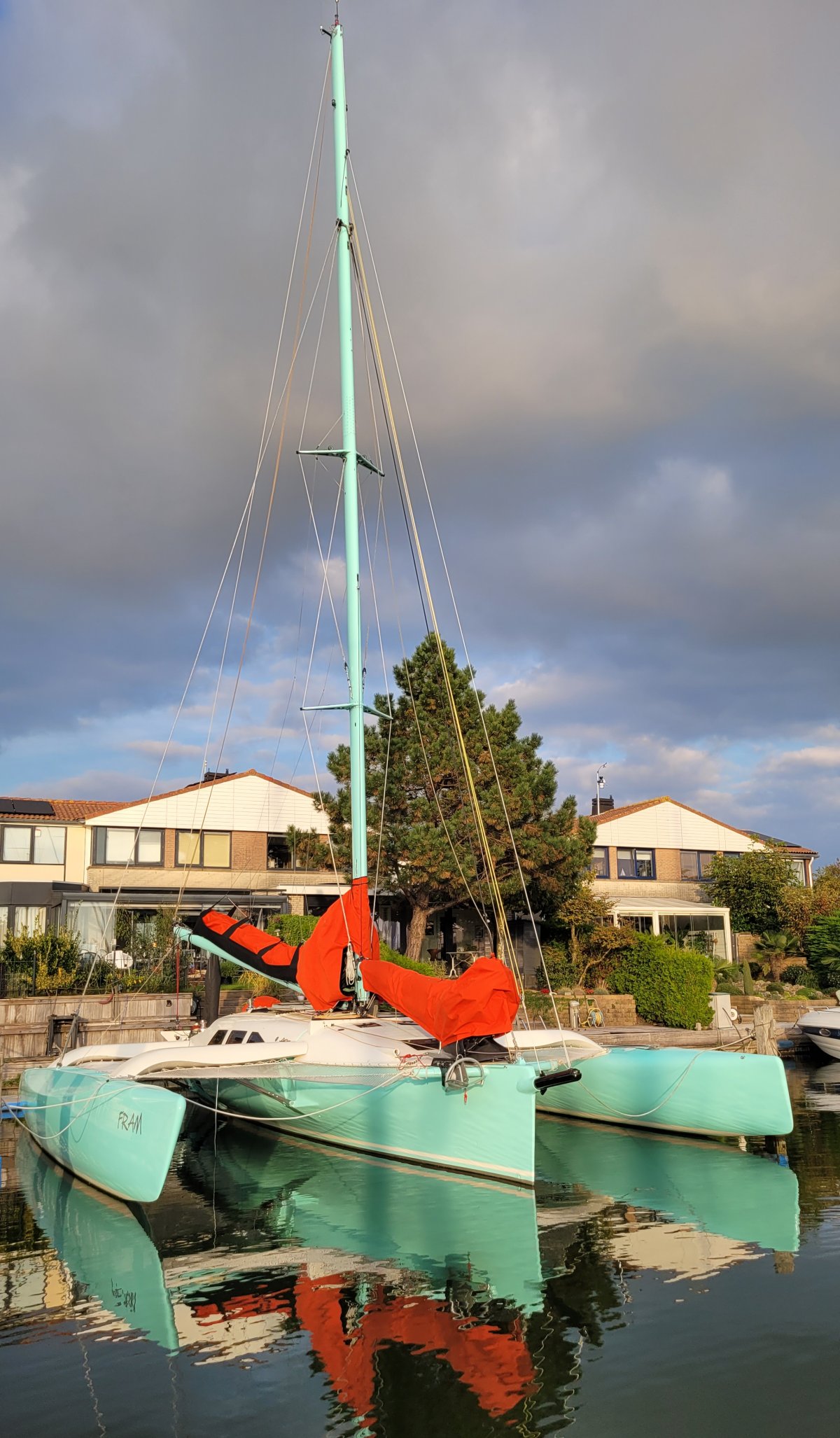
The propulsion systems of Fram are the result of deliberate choices balancing reliability, weight, manoeuvrability and offshore suitability.
Propulsion Systems
During the early preparations for the construction of Fram, I explored various propulsion concepts. In principle, my preference was for an electric drive. At the time, however, such systems were still in their infancy. The project itself already represented a significant technical challenge, and I deliberately chose not to add the additional complexity of developing an experimental propulsion system. Moreover, electric propulsion came with a considerable weight penalty due to the required battery capacity. I must also admit that several failed electric propulsion projects in multihulls— later converted to conventional diesel engines—reduced my confidence further.
Looking back, and considering the rapid development of electric drives and the increasing availability of affordable LiFePO4 battery systems, I might well have made a different choice today.
Although widely used on multihulls, an outboard engine was not a suitable option for Fram. Its main disadvantages are the concentration of weight at the extreme aft end, poor behaviour in waves—this is an ocean-going vessel— and the use of petrol, which is both highly flammable and often poorly available in a maritime context.
The final choice therefore became an inboard diesel engine driving a conventional propeller shaft. A saildrive would have simplified installation, but it would compromise the trimaran’s ability to dry out safely and was therefore rejected.
At the time I first wrote the engine section, the Smart CDI engine had just entered the marine market and appeared to be a promising option. Over time, and with growing experience, it became clear that this engine would not make it to the purchase stage. The final decision was therefore made in favour of the well proven and globally serviceable Yanmar 3YM30 diesel engine.
As the original engine page still attracts significant traffic via search engines and direct links, it has been archived and can be found here.
Fram can be challenging to manoeuvre. She is light, has considerable windage, and initially I considered installing a bow thruster. However, the shallow draft at the forefoot would require the thruster tunnel to be positioned further aft, reducing its effectiveness. This led to the idea of a retractable bow thruster mounted further forward in the bow.
After evaluating several systems, the disadvantages increasingly outweighed the benefits. Apart from placing additional weight in an unfavourable position, such systems are inherently vulnerable. I could easily imagine an anchor chain tearing off a protruding thruster unit.
The final choice for manoeuvring assistance therefore became a water-jet-based bow and stern thruster system: the Jet Thruster. Steering by water, rather than by exposed mechanical components.
Propulsion systems chapter pages
The design and construction of the propulsion system are documented in the following chapters, each focusing on a specific component and supported by a detailed photo gallery.
- Stern tube ~60 photos
- Aquadrive ~21 photos
- Engine installation ~60 photos
- Bow and stern jet thruster with video and ~54 photos