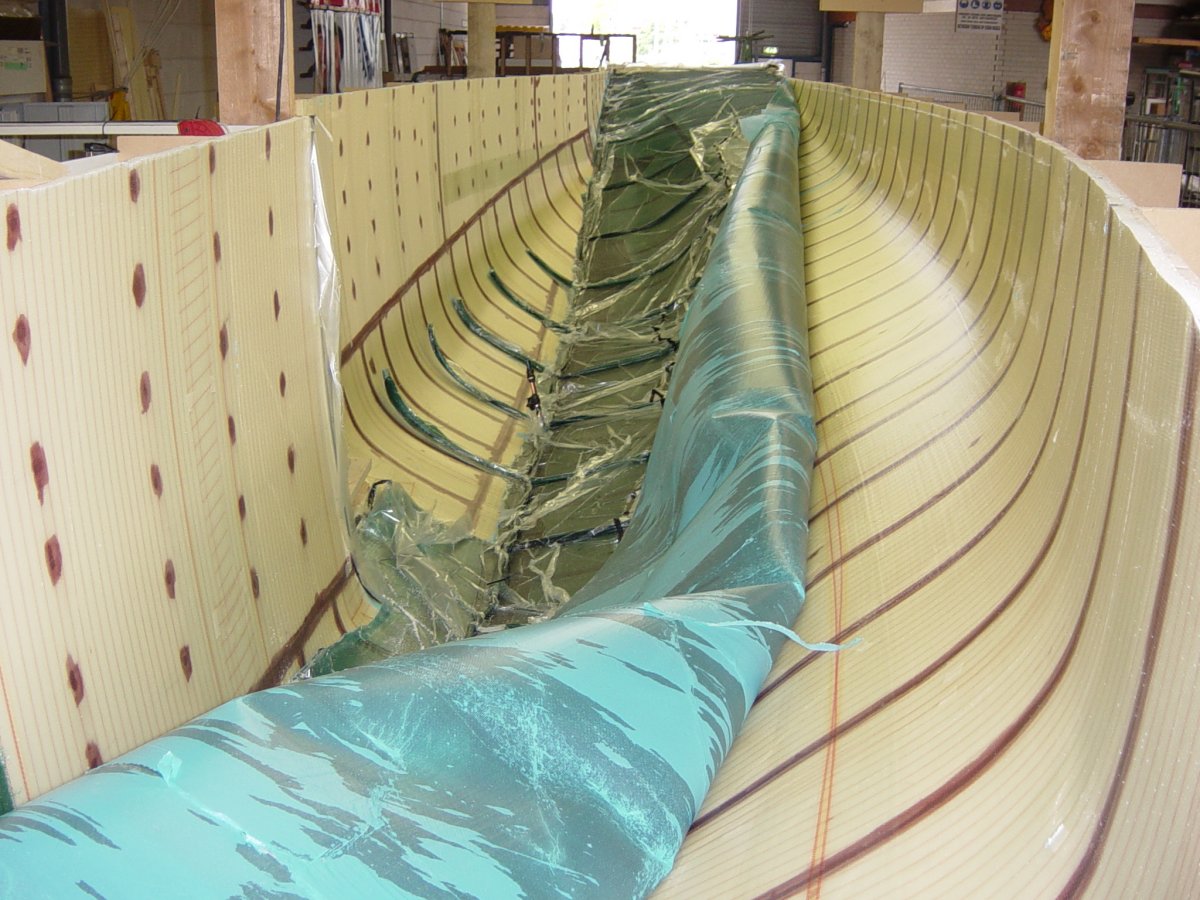
An introduction to the laminating processes and techniques used during the construction of the F-39 trimaran.
Laminating
A laminate is a composite material built up from multiple layers of reinforcement fabric bonded together by a resin matrix.
In this project, the laminate consists of an epoxy resin combined with several layers of glass fibre fabric or carbon fibre fabric. The resin forms the matrix: it wets the fibres, bonds the layers together, transfers loads between the fibres, and protects them from environmental exposure. The reinforcement fabrics provide the structural strength and stiffness of the laminate.
Each layer of fabric can be oriented in a specific direction to optimise strength for the expected load paths. By stacking multiple layers with varying fibre orientations, the laminate achieves high strength, stiffness, and durability while remaining relatively lightweight.
Several techniques can be used to saturate the reinforcement fabrics with resin. During the construction of Fram, I have used the following methods:
- Hand lay-up, the simplest and most widely used technique, applied to all reinforced fillet connections between bulkheads and hull;
- Vacuum bagging, an enhancement of the hand lay-up process, used for some smaller parts with more complex shapes;
- Vacuum resin infusion (VARTM / SCRIMP), used for higher-quality structural parts, including all hulls and bulkheads;
- Compression moulding, where a pre-measured laminate is placed in a mould and compressed during curing, used for some smaller components.
For completeness, but beyond the scope of this project, other laminating techniques should be mentioned. These include prepreg lamination, which uses fabrics pre-impregnated with a precisely controlled amount of resin; spray-up lamination, where chopped glass fibres and resin are sprayed simultaneously into a mould; and filament winding, in which resin-impregnated fibres are wound under tension over a rotating mould.
The glass fibre tubes used for various purposes on Fram, such as lashing tubes, are manufactured using the filament winding process.
The following chapters provide a more detailed description of the laminating techniques applied during the construction of the F-39 trimaran.