An explanation of how virtual modelling and resin flow simulation were used to design and validate the vacuum infusion process before actual construction.
Virtual boatbuilding
The real breakthrough for me was gaining access to specialised knowledge at polyworx, in the person of Arjen Korevaar. He is the developer of the highly specialised resin flow simulation software RTM Worx, which allows the infusion process to be simulated on a computer before it is carried out in practice.
Arjen introduced me to the principles of vacuum infusion, the required equipment and consumables, provided on-site training, and—most importantly—gave me the confidence that I could apply this technique successfully to the construction of my boat.
As a single-handed boatbuilder, it was essential that I could execute the entire process independently, without relying on additional helpers. This is only possible if the infusion strategy is designed in such a way that a single resin feed line is sufficient—meaning only one resin bucket needs to be monitored and kept filled. No switching of feed lines, no opening and closing of multiple valves during the infusion process.
Equally important is that the resin front advances uniformly throughout the laminate towards the vacuum line or vacuum point. As an additional safeguard, the vacuum line can be subdivided into sections in case resin flow accelerates unexpectedly in certain areas. This behaviour is easy to monitor. Although I incorporated this option in the design, I never actually needed to use it.
All of this became possible through the use of flow simulation software, which effectively eliminates guesswork. Infusion strategies that do not work are quickly identified and discarded, while alternative approaches can be tested without any risk. Costly trial laminations are no longer necessary, and no time or materials are wasted, as everything can be evaluated on the computer first.
The simulation engine is based on finite element and control volume methods to solve the physical equations governing resin flow through a porous medium.
When CAD files are available, it is possible to import 3D geometry from STL, DXF, or PATRAN files. In practice, however, access to such files is often restricted due to copyright, licensing, or confidentiality concerns. Most designers are understandably reluctant to provide full CAD data. As Ian Farrier once explained to me, supplying these files would be comparable to Microsoft giving away the complete source code of Windows.
RTM-Worx also includes an integrated geometry editor, making it possible to create a custom 3D model directly within the software.
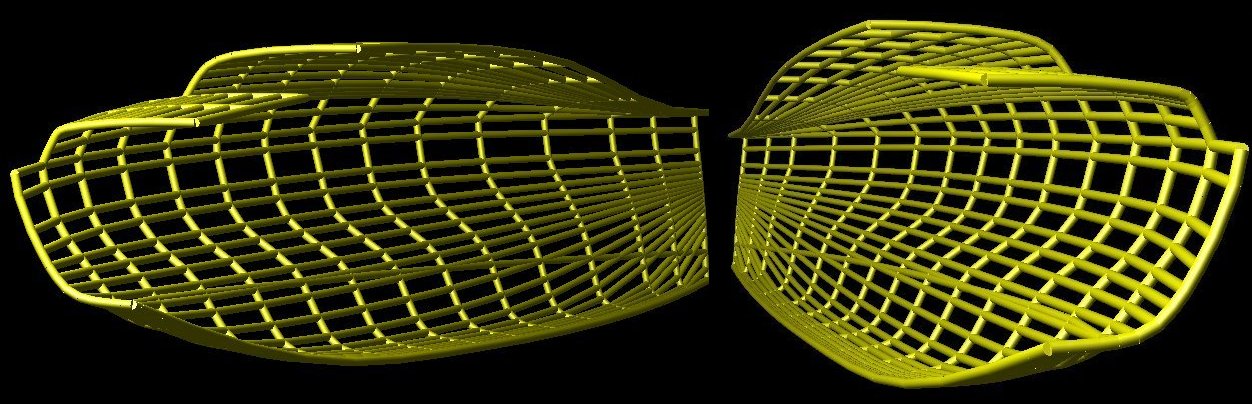
This photo gallery presents a selection of such generated 3D models of the floats and main hull, rendered with thin line segments and tubular representations for clarity.
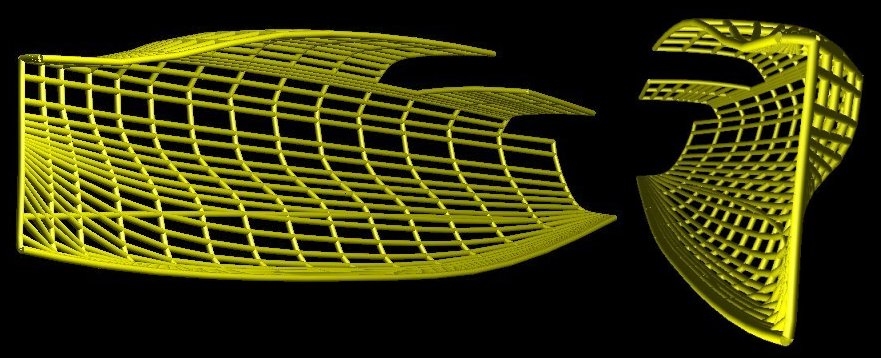
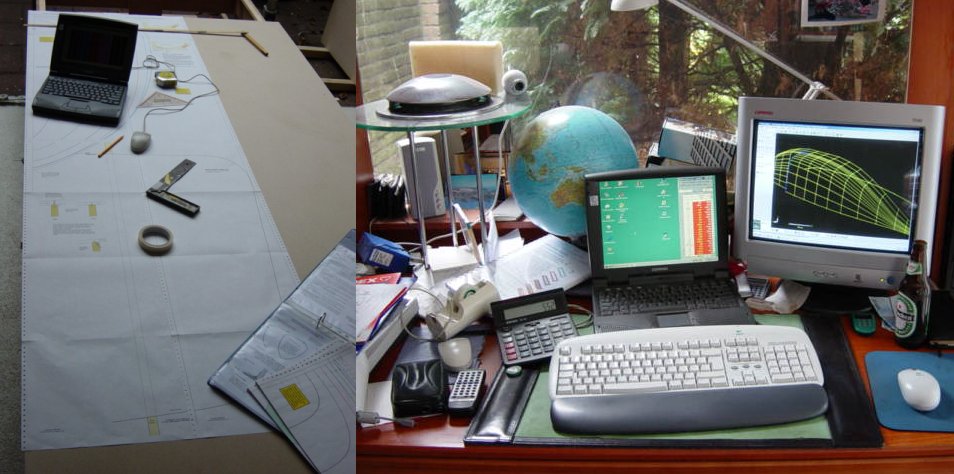
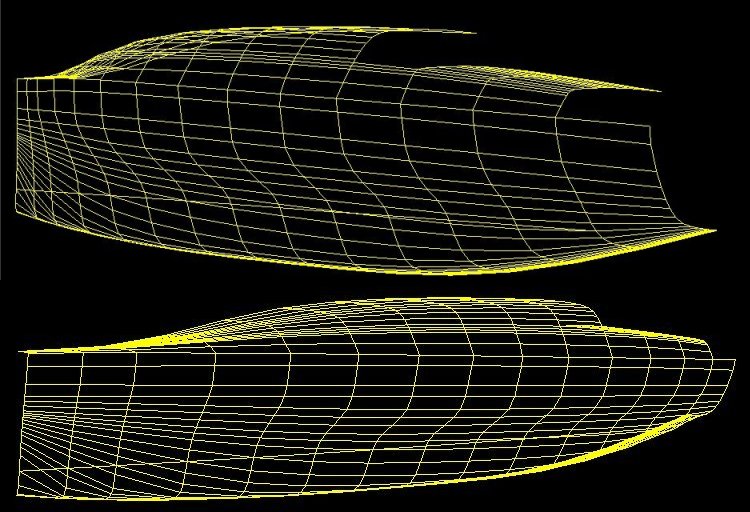
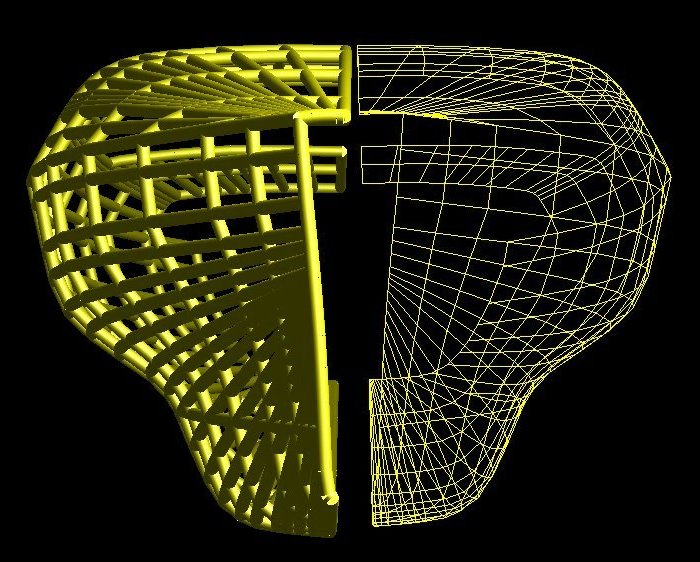
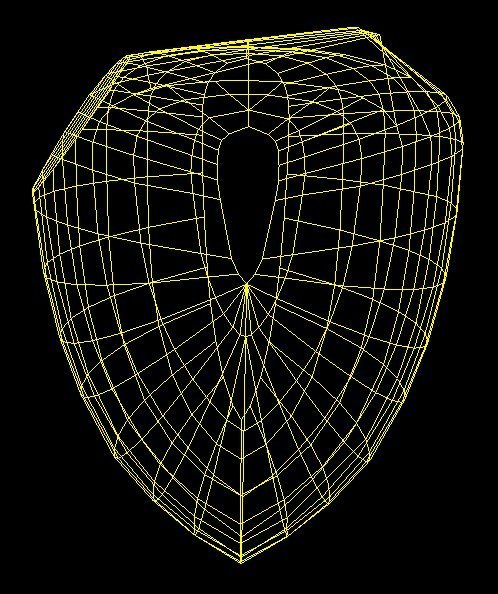
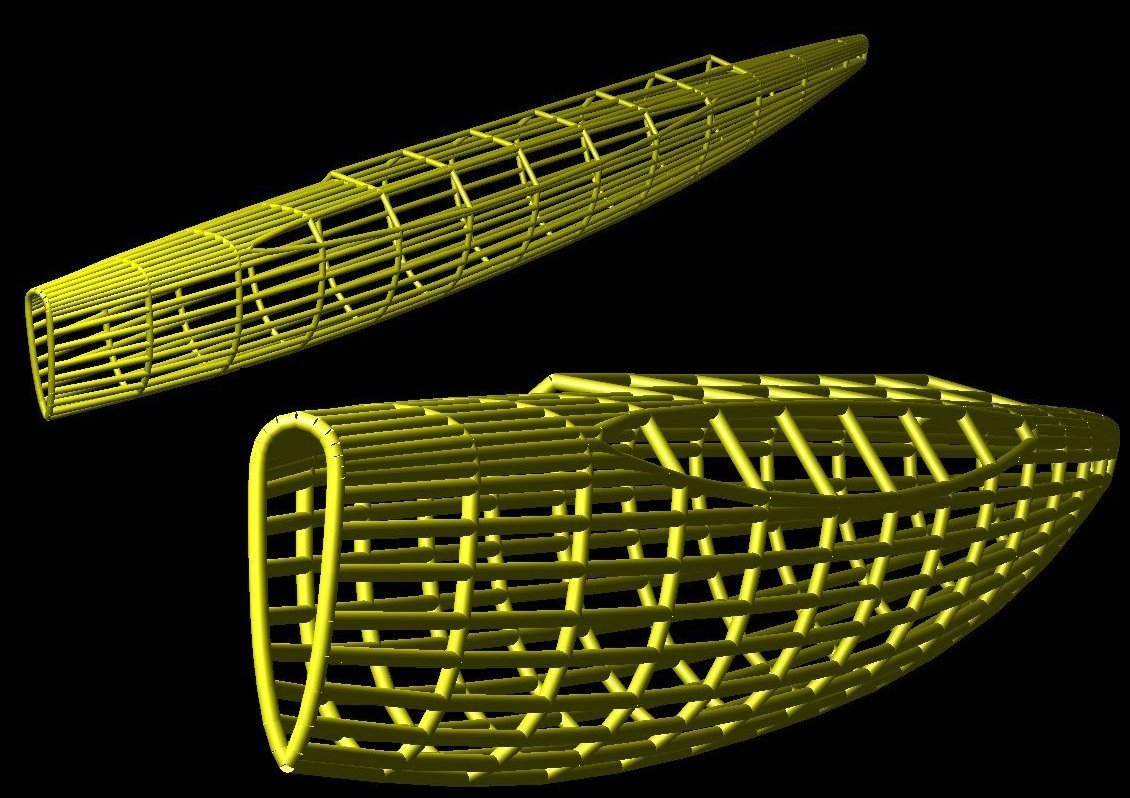
It took me four days to convert the two-dimensional full-size patterns of the F-39 into a sufficiently accurate three-dimensional model. To achieve this, I added diagonal reference lines to the station drawings, creating a three-dimensional grid. The corresponding coordinates—easily obtained through manual measurement—were entered into RTM-Worx, after which the key points were connected using curves.
This process immediately reveals any remaining inaccuracies or imperfections. These become particularly visible when the model is rendered using thicker line segments or tubular representations. It is essential that all lines are properly connected without gaps, as even minor discontinuities affect the simulation results.
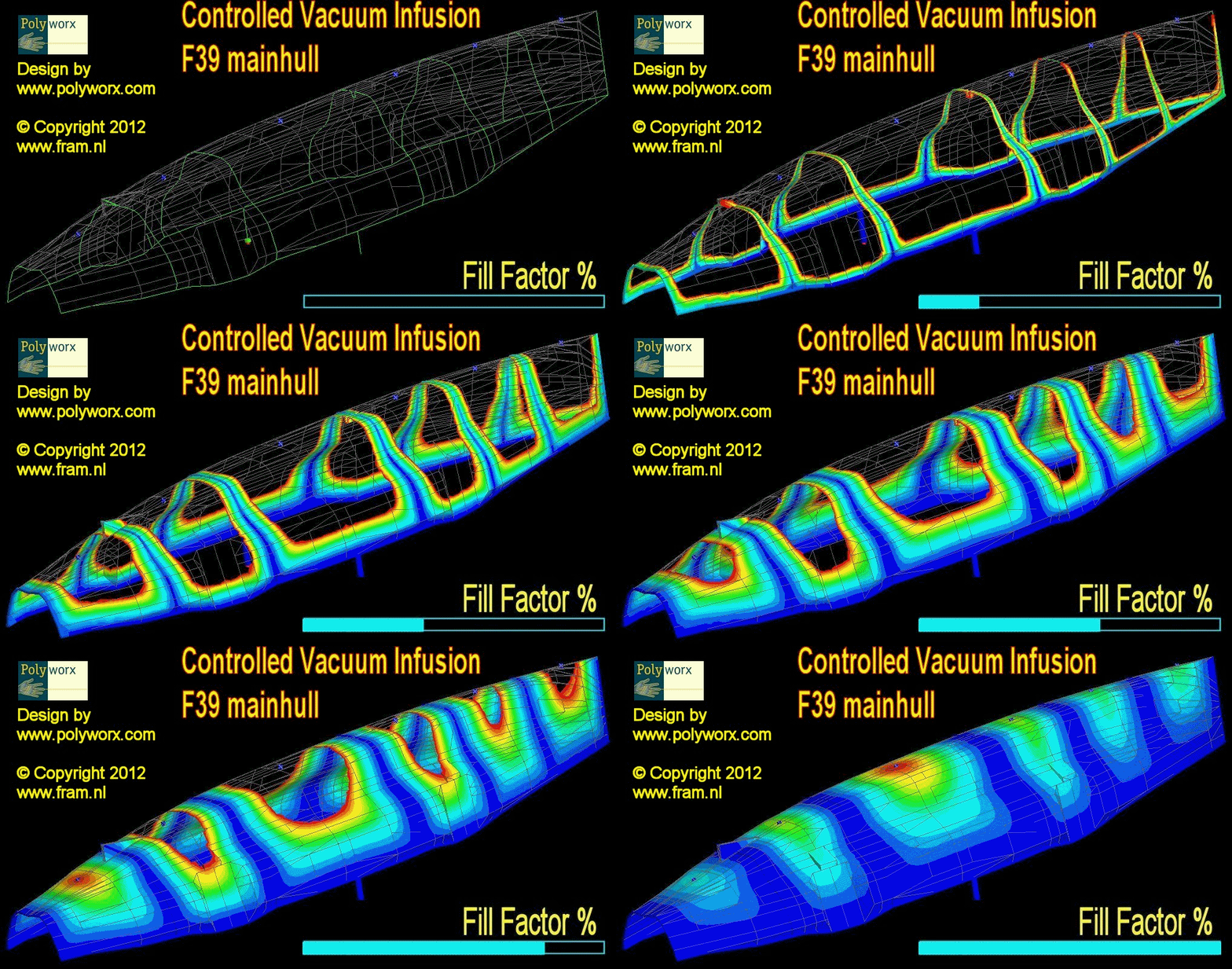
The next step is to add runners, resin inlets, vacuum outlets, gravity direction, and material properties of both resin and reinforcement fabrics—particularly permeability. This is the critical input that ultimately defines the infusion strategy. At this stage, however, it is still only the computer performing the infusion.
By varying the layout of infusion materials, optimal results can be achieved. The effects of each change are clearly visible in controlled simulations of the infusion process. Below is an example of a calculated animation showing the resin flow during infusion of the main hull bottom.