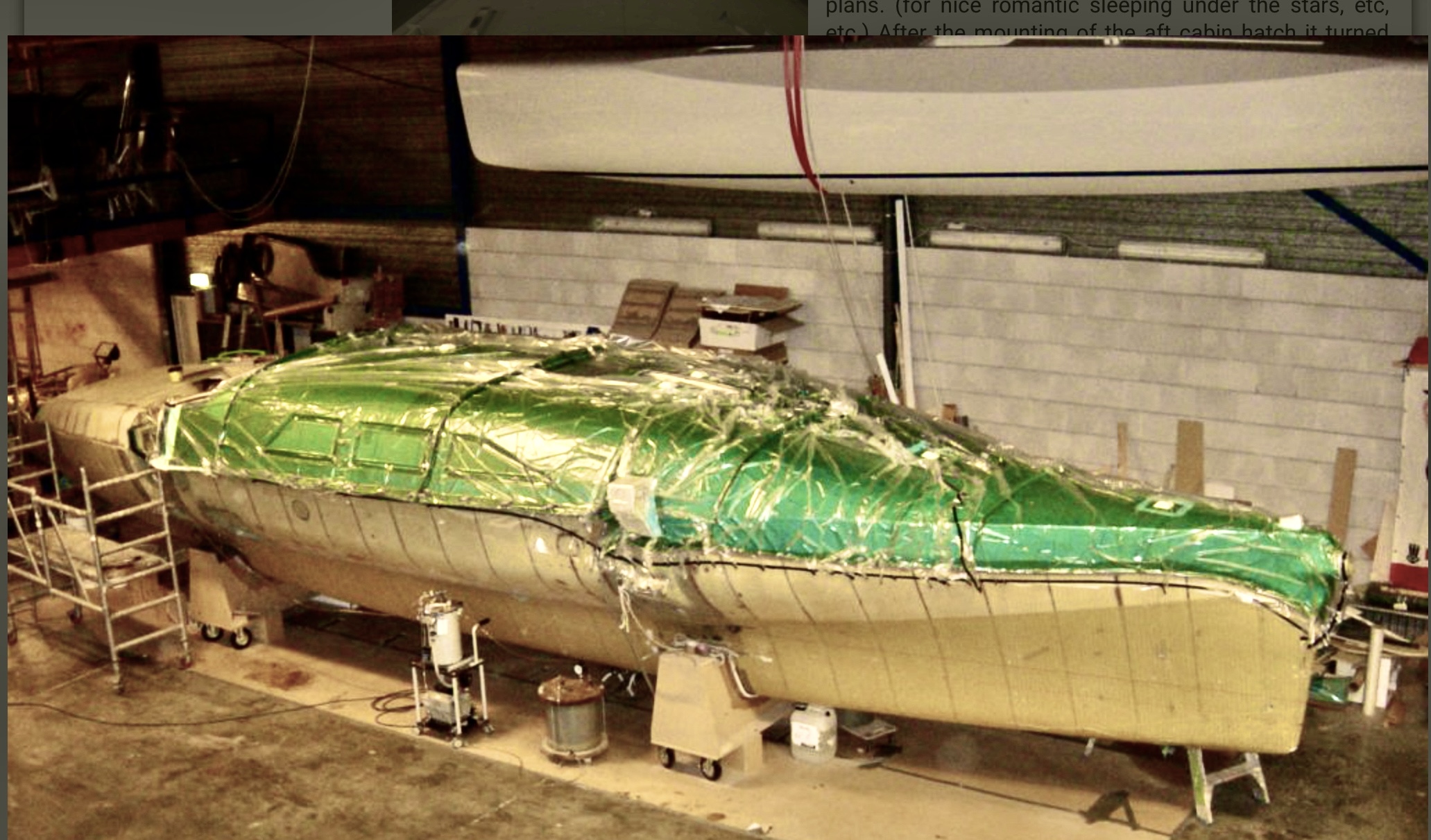
An in-depth explanation of how vacuum infusion was adapted and successfully applied to the construction of Fram, from concept to full-scale hulls.
Controlled Vacuum Infusing Fram
Vacuum resin infusion is, in my view, the most advanced and effective laminating method available for the Fram project, representing a major step forward in terms of laminate quality, consistency, and control.
This technique allows me to work in a truly modular way. The dry lay-up can be done piece by piece, working alone in spare hours. The entire vacuum assembly can be prepared at a relaxed pace, and only when everything is ready is the vacuum applied, the resin mixed, and the laminate infused.
A successful infusion requires an airtight mould. In the method described here, the upper side of the mould is formed by an airtight plastic vacuum film, sealed to a flange around the mould perimeter. In professional yacht construction, such moulds are standard and allow series production. For a one-off project, however, this approach is impractical unless unlimited budget and manpower are available.
The hulls of Fram consist of a sandwich structure of laminate skins and Corecell foam, assembled in a temporary building frame. This raised an obvious question: why not use the foam itself as the mould? Despite negative advice from both the designer and the foam supplier—who indicated that this approach had been tried before without success—I decided to investigate the concept further.
One suggestion was to first apply a thin hand-laminated skin of approximately 200 g/m² glass fabric to create an airtight surface. However, this would already account for more than 30 percent of the required inner laminate, which did not align with my way of thinking.
The 15 mm Corecell foam I use is inherently airtight, something I verified through my own testing. This means that only the seams between foam panels require special attention. From this, I concluded that it should indeed be possible to use bare foam as the mould surface for vacuum infusion.
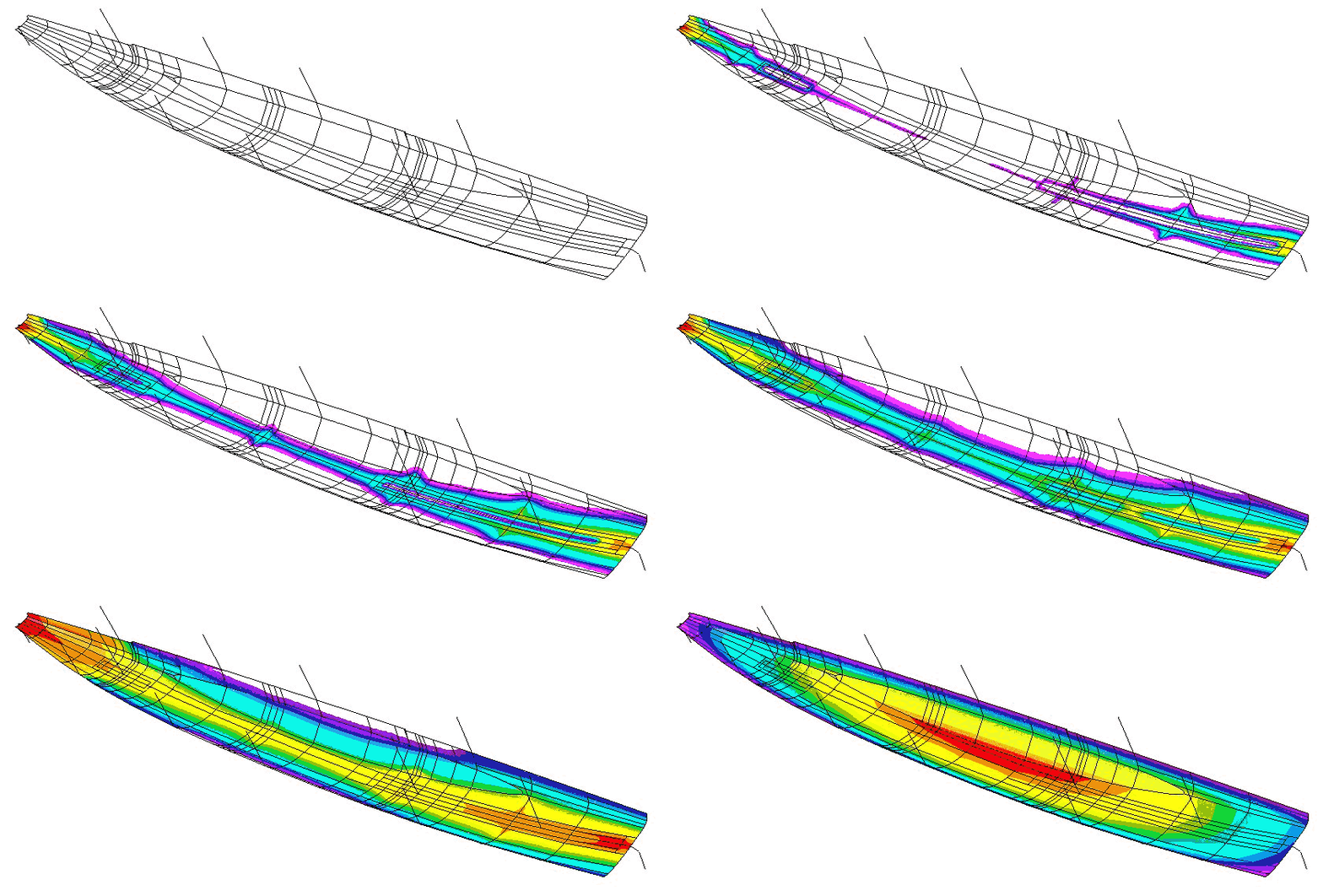
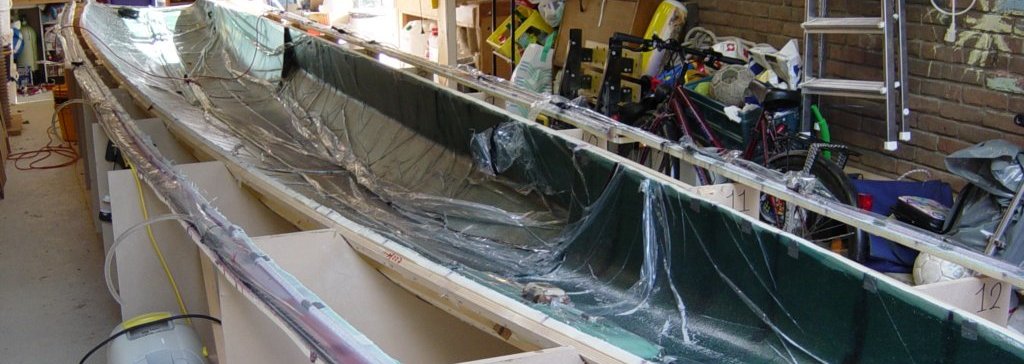
Around the same time, Ian Farrier introduced the vertical foam stripping method. Instead of narrow longitudinal strips, the foam is applied in much wider vertical strips. This requires thermoforming of the foam, which is not necessary with the traditional longitudinal method (known in the Netherlands as the “woodcore method,” albeit using foam instead of wood).
Although vertical stripping requires some additional work on the building frames—adding longitudinal wooden battens to support the foam strips—it significantly reduces the number of joints in the foam. These remaining seams can be milled open and filled with thickened epoxy, ensuring airtightness. An additional advantage is the clean working process, as no sticky adhesives are required during foam assembly.
The flange required to attach the vacuum film can be created simply by cutting the foam approximately 10 cm longer than strictly needed for the hull shape.
Most important to me is the reassurance that this technique is entirely process-driven. Laminate quality is governed by controlled parameters such as vacuum level, resin viscosity, flow paths, temperature, and timing. Quality is no longer dependent on human variability—my own skills included. Once the process is properly designed, results become consistent and repeatable, both structurally and cosmetically.
Vacuum infusion is not limited to hull construction. Interior panels and bulkheads are also produced using this technique. For these components, I use a double-sided infusion method, in which both laminate skins on either side of the foam core are infused simultaneously.
For this purpose, I built a flat infusion table covered with Formica to ensure perfect flatness. To allow resin and air to pass from the lower laminate to the vacuum side, the foam core is perforated at regular intervals of approximately 25–50 mm.
The first half of a float hull was used as a full-scale test piece to validate the entire setup in practice. This was carried out using a small, antique vacuum pump and proved to be a complete success. I subsequently performed seven major infusions with this pump, including the infusion of the first 40-foot main hull half.
As the process matured and became more familiar, later infusions were carried out using more professional vacuum pumps, generously sponsored by vacmobiles.com.
As always, the devil is in the details. Vacuum bag leaks can be showstoppers, and incomplete infusions may occur due to issues such as race-tracking. Details such as incorporating a resin break to stabilise and slow the resin front near the vacuum line also proved important.
One early issue was the imprint left by spiral vacuum hoses on the laminate surface. Even with a stiffer flow medium underneath, this proved difficult to avoid initially. Over the course of many infusions, I continuously refined the hose layout inside the vacuum bag.
Hoses tend to shift easily on the smooth fabric surface, and once the bag is sealed, adjustments are no longer possible. The final solution was to integrate the hoses into a fold of the flow medium. This both fixes them in position and prevents imprinting, as the hoses effectively “float” above the laminate when carefully positioned at the crest of the fold.
Some people suggested that vacuum infusion of large hulls requires large, professional vacuum pumps. I considered this a misconception. A vacuum is a vacuum: with an airtight bag, a small pump can achieve the same vacuum level, albeit more slowly. My experience confirmed that this reasoning was correct.
Note: since then, this approach has become widely accepted. Vacuum infusion on bare foam substrates is now commonly used with great success, and even Farrier adopted vacuum infusion for the production of his later F-boat designs.