Understanding vacuum starts with understanding pressure units—SI, metric, imperial and mercury-based—and how they relate in practice.
Units (SI, Metric, Imperial, Mercury)
To understand vacuum, you need to know a little about how pressure is measured. The SI unit for pressure is the pascal (Pa), defined as one newton per square metre (N/m²). Meteorologists often prefer the hectopascal (hPa) when describing atmospheric pressure, which is numerically equivalent to the commonly used millibar (mbar).
Because pressure can be measured by its ability to displace a column of liquid, other units are also in common use. These include the inch of mercury (inHg) and the millimetre of mercury (mmHg). One millimetre of mercury is equal to one Torr, a unit named after Evangelista Torricelli, the Italian physicist and mathematician who discovered the principle of the barometer. And finally, a somewhat more obscure unit—at least to those of us raised in the metric system—is the imperial pound per square inch (psi).
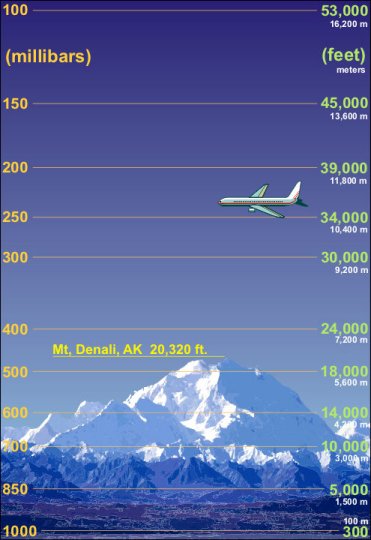
The atmospheric pressure we experience on Earth is caused by the weight of the air column above the measurement point. For this reason, it varies with altitude above sea level. The standard atmosphere (atm), however, is a defined constant. It is approximately equal to the average air pressure at mean sea level and is defined as follows:
1 atm = 760 Torr = 29.92 inHg = 14.7 psi = 101.3 kN/m² = 1013 mbar = 1013 hPa
In practice, atmospheric pressure at sea level typically varies between about 980 mbar and 1030 mbar. Pressures below 900 mbar have been recorded in the eyes of cyclonic systems, while values above 1080 mbar have been measured under very calm and cold conditions. At the summit of Mount Everest, atmospheric pressure averages only about 300 mbar.