Gauge vacuum is relative to atmospheric pressure, while absolute pressure is not. Understanding the difference is essential for reliable vacuum infusion.
Gauge Vacuum and Absolute Pressure
The barometer in our home or on our boat measures absolute pressure—also called atmospheric pressure. Its reading represents the pressure above absolute zero, or perfect vacuum.
The vacuum in a vacuum bag or resin trap, however, is measured using a vacuum gauge. This reading is relative to the surrounding atmospheric pressure and is usually expressed in barometric units or as a percentage of atmospheric pressure. This relative measurement is known as gauge vacuum: it represents the pressure difference below ambient atmospheric pressure. In fact, a vacuum gauge works in the opposite way to a barometer.
The absolute pressure inside a vacuum bag or resin trap is therefore equal to the current atmospheric pressure minus the indicated gauge vacuum, using the same units. In other words, the driving force that pushes resin into the laminate is the pressure difference between atmospheric pressure and the absolute pressure inside the bag.
The good news is that here in the low countries (the Netherlands), I have slightly more available pressure and can infuse over a longer distance than someone building in the mountains of Italy or Colorado…
…the bad news is that I live in a wet country at the end of the North Atlantic track of depressions (low-pressure systems), while builders in the mountains more often enjoy stable, high-pressure weather.
This means that the residual pressure inside a laminate may differ from the gauge reading due to changes in atmospheric pressure caused by weather variations or altitude differences.
For example, at sea level and standard conditions (29.9 inHg), a gauge vacuum of –25.9 inHg corresponds to an absolute pressure of 4 inHg. In other words, a vacuum gauge reading –25.9 inHg at “full vacuum” is actually reporting an absolute pressure of about 4 inHg, or roughly 136 mbar. That still falls within what is classified as a low vacuum.
Vacuum infusion, however, ideally operates in the medium vacuum range— that is, at an absolute pressure below about 1 inHg (35 mbar). Unfortunately, the accuracy of many common vacuum gauges is only about 1.5 inHg (50 mbar). This is where the desire for an absolute pressure gauge comes in.
An absolute pressure gauge measures directly relative to absolute zero and is unaffected by weather conditions or altitude. Different pressure scales can be used for both gauge and absolute measurements; the relationships between some of the more common ones are shown below.
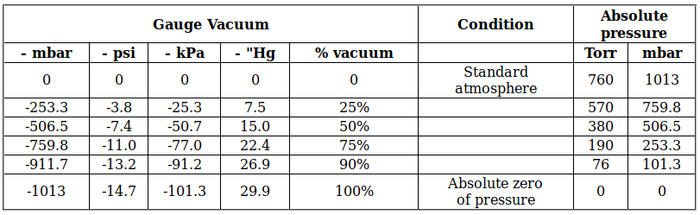
Note that percentage vacuum is an intuitive scale, independent of SI or imperial units. That said, scientists working in the—admittedly far removed—ultra-high and extremely high vacuum ranges rely exclusively on absolute pressure measurements. In time, the high-tech composite builder will inevitably follow the same path.