Large central vacuum systems are common in older yards, but multiple small independent units offer greater flexibility, reliability, and vacuum performance.
Large Central Vacuum Systems vs. Small Individual Units
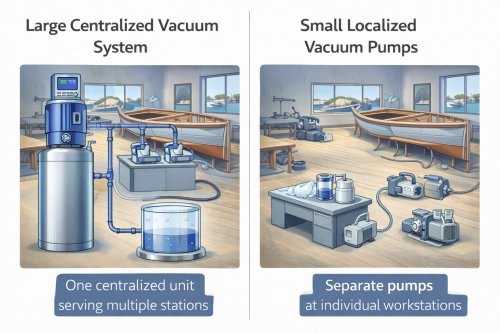
I dare to say that the large centralized vacuum systems often found in (older) boatbuilding yards are largely outdated. Using multiple small, independent vacuum systems is a far more flexible and effective approach for the production of composite parts and boat hulls.
When preparing the infusion of a large hull, several small vacuum systems can be used for initial evacuation and leak testing. Once the system is stable, a single pump is sufficient to maintain the vacuum and perform the infusion. At the same time, other composite components can be produced elsewhere in the shop without interference or competition for vacuum capacity.
This approach eliminates the need for expensive vacuum piping running throughout the facility and greatly reduces the ongoing struggle with system-wide leaks. For redundancy and safety, vacuum integrity is further improved by the presence of more than one independent vacuum system.
Large central vacuum systems usually cannot achieve the same high vacuum levels in the bag, and almost never do so when multiple vacuum applications are running simultaneously. Even if the central pump has superior specifications on paper— both in ultimate vacuum capability and pumping capacity— it typically will not outperform a good, small, dedicated vacuum pump connected directly to the job.
Why is this?
One reason is that the extensive and complex pipework associated with central vacuum systems is inherently prone to leakage. Even very small leaks can significantly reduce performance. This effect will be demonstrated further down in this chapter.
Another, and often more important, reason is that vacuum cannot easily be “shared” between multiple applications that require different vacuum levels at the same time. Unless the central system has an enormous surplus capacity, the largest vacuum demand at any given moment will determine the vacuum level available throughout the plant.
For example: if one application is vacuum-bagging a large hull at 70% vacuum while another is attempting to infuse a small component, the maximum vacuum available to the infusion will be limited to that same 70%— even if the central pump is theoretically capable of achieving 99.9% vacuum.
What options are available if your shop already has a central vacuum system and you want to introduce vacuum infusion?
One possible approach is to install zero-loss vacuum regulators at each vacuum connection point and carefully adjust them to provide no more vacuum than required for each application. When correctly set, these regulators can reduce overall vacuum load and improve the maximum vacuum level available across the system.
However, because central systems often suffer from widespread leakage, the achievable vacuum level for infusion may still be inferior to that of an independent pump setup and energy consumption is likely to remain higher. Zero-loss vacuum regulators are also relatively expensive, and if they are not correctly adjusted, they offer no benefit at all.
It is important to note that conventional vacuum regulators, which simply admit air to reduce vacuum, are entirely unsuitable in this context. They are effectively controlled leaks and do nothing to improve overall system performance. In fact, the poorest vacuum setting will limit the entire plant.