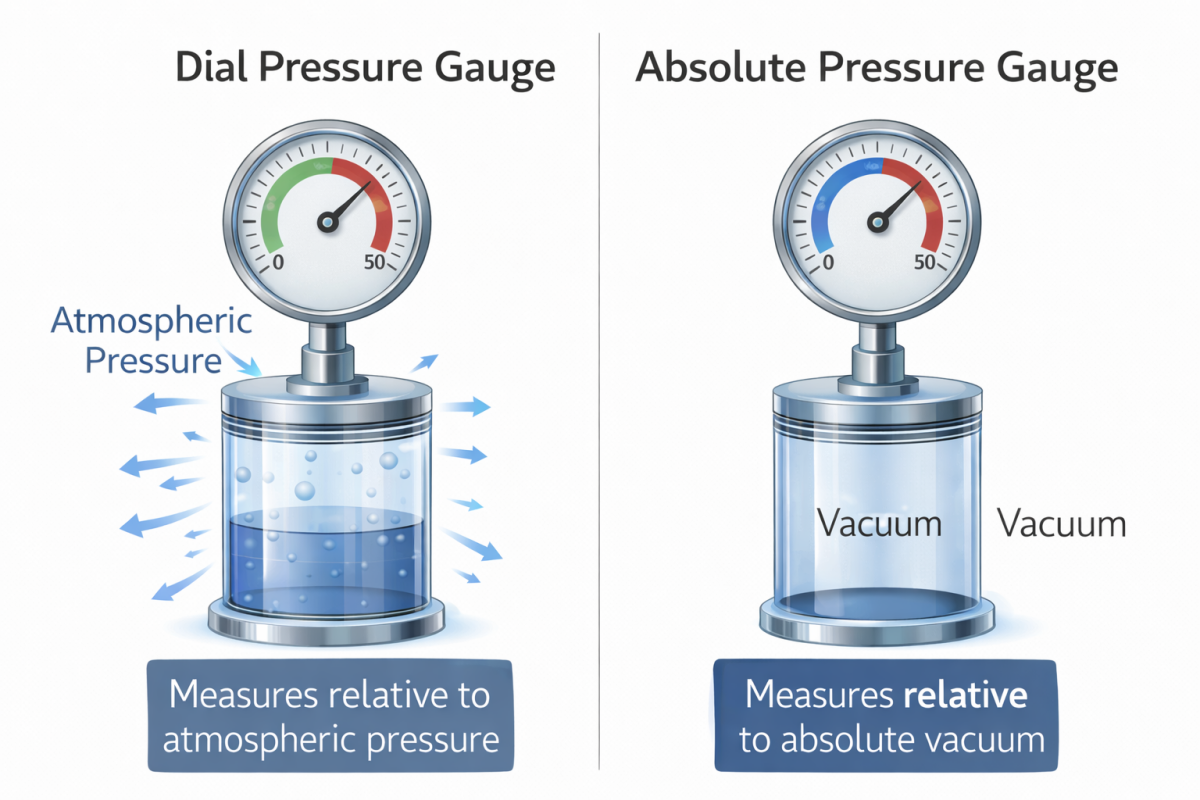
Accurate vacuum measurement requires understanding the difference between dial gauges and absolute pressure gauges, especially at low absolute pressures.
Dial Gauge or Absolute Pressure Gauge ?
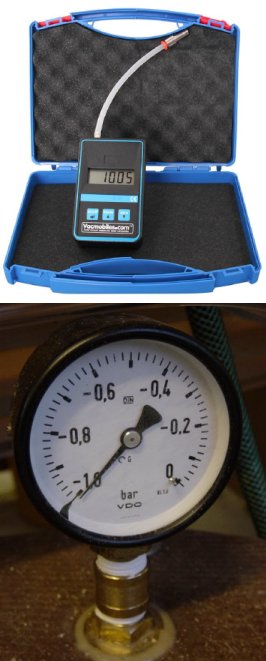
A digital absolute pressure gauge, also known as a precision vacuum gauge, responds much faster to pressure changes than the conventional dial gauges typically fitted to vacuum pumps or resin traps. When such a gauge is used, the traditional vacuum gauge is reduced to little more than a general-purpose indicator.
The residual pressure inside a vacuum bag may differ significantly from the gauge reading because atmospheric pressure varies with weather systems and altitude. For high-quality resin infusion work, it is therefore preferable to use an absolute pressure gauge. It measures pressure relative to the absolute zero of pressure and is unaffected by weather or elevation, allowing you to know exactly what is happening inside the vacuum bag.
As discussed in the chapter on vacuum pumps, a good-quality oil-lubricated rotary vane pump, suitable for vacuum infusion or prepreg work, will typically achieve an absolute pressure in the range of 10 to 20 mbar at the pump inlet. It is not uncommon for such pumps to achieve absolute pressures in the vacuum bag of around 20 to 30 mbar.
To verify that a lay-up has been evacuated to this level, the measuring instrument must be accurate in this low-pressure region. This requirement is far beyond the capabilities of a conventional dial vacuum gauge. Atmospheric pressure variations alone can introduce errors of ±25 mbar, while mechanical inaccuracies in the gauge typically add another 1–3% of full scale, easily contributing an additional ±30 mbar.
It should be clear that a vacuum gauge with a combined uncertainty of around ±55 mbar is entirely unsuitable for measuring an in-bag vacuum in the range of 10 to 30 mbar. Referring to the diagram and ignoring mechanical gauge inaccuracies, it can be seen that on a “good” day a pump may appear to achieve 30.1″Hg, while on a “bad” day only 28.6″Hg.
In reality, the pump does not have good days or bad days. The variation is caused entirely by changes in atmospheric pressure. The difference between these readings, 1.5″Hg, is far greater than the 10 mbar (approximately 0.3″Hg) we are actually trying to measure.
A further complicating factor, and another reason to understand absolute pressure, is the presence of moisture retained in composite materials. Out-gassing effects, as discussed earlier, can only be properly interpreted when using an absolute pressure gauge.
For accurate and reliable in-bag vacuum measurement, the use of an absolute pressure gauge is therefore essential.
As a side benefit, a digital absolute pressure gauge also functions as an excellent barometer. Every serious sailor should have one.