An explanation of what defines a trimaran, followed by my personal discovery of the concept and the reasons behind choosing a Farrier trimaran.
Trimaran
A trimaran has three hulls: a relatively large central hull, with a smaller outrigger on each side. Most trimarans are large enough to provide sleeping accommodation in the main hull, although interior volume is generally less than that of a comparable monohull.
The outriggers may be fixed or folding. In general, trimarans are lighter and faster than cruising catamarans. Today, most sailing speed records are held by trimarans. Compared to catamarans they heel more, and in extreme conditions may sail with only one float in the water.
My discovery of the trimaran
I can no longer recall exactly when I first began to consider a trimaran as a serious option for the multihull I had in mind. Until then, trimarans had seemed like strange, exotic creatures—fast, perhaps, but awkward and unattractive. I encountered Formula 40 racing trimarans in France as if they had come from another planet. At that time, my interest in multihulls leaned more towards catamarans, preferably of a sporty design, without a “caravan-like” deckhouse between the hulls.
Through a tip from a colleague, I discovered the folding F-boat trimarans—odd, folded birds that could be trailered behind a car. To me, they initially appeared to be little more than day sailors, with hardly any accommodation inside.
Then came our annual HISWA Boat Show in Amsterdam. On the far side of the exhibition, a strange and rather ungainly bird caught my attention. Moored along the jetty was a half-built, unpainted trimaran with one float folded; the other was not yet completed.
Originally conceived as a home-built project, this boat was being shown to gauge interest in the TRIMAX design and to explore the possibilities of a production version—TRI for trimaran, MAX for speed and accommodation.
Squinting at her lines, I began to see the beauty of her hull. With a length of 35 ft and a surprisingly practical interior, this design by Dutch designer Peter Bosgraaf deserved closer inspection. It offered me a completely new perspective on trimaran concepts.
I sailed the prototype of the Trimax trimaran—and I was hooked.
Nevertheless, there were many aspects that still required improvement, which was understandable given the prototype nature of the boat. Early buyers were offered a discount, but the price was beyond my budget. Moreover, the lack of proven experience and the feeling that I would be supporting an experiment did not sit well with me. The folding system also appeared to be a derivative of the Farrier Folding System.
Even so, this was the first crucial step toward choosing the boat that would become “my dream boat”. After a lifetime of monohull sailing, the decision to move to a trimaran was made. The combination of very high sailing speeds and shallow draft promised an entirely new way of sailing.
Around the same time, I discovered the Internet—still via a dial-up modem. Shamelessly, I roamed the web in search of multihulls, and trimarans in particular. I rediscovered the Farrier F-boats and, to my surprise, found that a larger version was available: the F-36. This was exactly what I needed. Not an experiment, but a proven design with an excellent reputation and everything in the right place. The interior even appeared more spacious than that of my 36 ft monohull, Senta.
After purchasing the study plans and carefully examining Farrier’s website, the decision was easily made. The decisive factors were the exceptionally detailed construction drawings and the building method. The more I studied the plans, the more I realised that this boat is an engineering masterpiece—supported by a construction method that I could realistically manage. All the essential ingredients for a high-quality yacht were present.
One question remains to be answered in practice. Twice in my sailing life, my boat had to take care of both herself and her crew. With all hatches closed and everything secured, there was nothing left to do but wait inside for conditions to ease. Outside, there was only salt water and very little air.
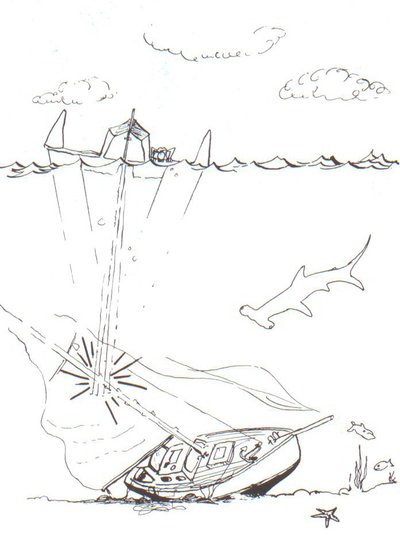
Heavy-weather tactics with a trimaran are different. A trimaran requires more attention and more active management. Where a monohull may forgive mistakes, a trimaran does not. If she capsizes, she remains capsized. This does not mean that a trimaran is unsafe in severe conditions, nor that a monohull is immune to the ultimate hazard of sinking. Ultimately, the multihull’s worst-case scenario—capsize—is less severe than that of a monohull—sinking. After all, a trimaran’s ultimate stability position is floating upside down, where it functions as a very effective liferaft. A monohull’s ultimate stability position is on the seabed, where it becomes a fine fish habitat. Arthur Ransome)
An F-boat is unsinkable due to its multiple watertight compartments, the materials used in its construction, and the absence of heavy ballast. There is considerable reassurance in knowing that, regardless of circumstances, the trimaran cannot sink. (Each year, approximately 7,000 containers are lost overboard by commercial shipping.)
At the same time, the trimaran’s speed makes it possible to avoid the worst conditions altogether. High performance often allows one to outrun deteriorating weather and reach a safe harbour, while slower vessels are forced to remain at sea.