A technical overview of fiberglass fabrics and resin systems used in the construction of the F-39 trimaran, including material choices and processing considerations.
Structural Composite Laminate
A fabric is defined as a manufactured assembly of long fibres of glass, carbon, aramid, or a combination of these, arranged to form a flat sheet consisting of one or more fibre layers. Most of the fabrics used in the F-39 are non-woven biaxial fibreglass in 0°/90° and ±45° orientations. Where concentrated loads are expected, unidirectional (UD) fabrics are used, with the majority of fibres running in a single direction.
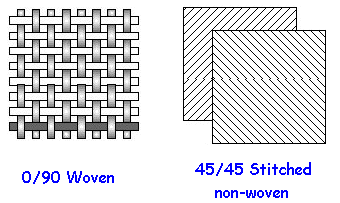
Both fabric types are non-woven. In traditional woven fabrics, the interlacing of warp (0°) and weft (90°) fibres introduces crimp, wrinkles, and fibre kinks, which reduce strength and stiffness. The fabrics used here are produced by a stitching process that combines multiple layers of unidirectional fibres into a single fabric. Because the fibres remain straight, crimp and shear effects are eliminated, resulting in significantly improved mechanical properties.
An additional advantage of stitched fabrics is the higher fibre-to-resin ratio. Improved fibre packing reduces the amount of resin required, as these knitted fabrics contain less interstitial space to be filled with epoxy.
For structural and weight reasons, fibreglass is replaced by carbon fibre in certain parts of the construction. These include the beams, chainplates, daggerboard, and rudder. I do not believe in local carbon reinforcements combined with fibreglass—when carbon is used, it is used throughout the component.
Polyester and vinylester resins are suitable and relatively inexpensive. In fact, the design itself is engineered with polyester in mind. Traditionally, chopped strand mat (CSM) is used between woven roving layers and foam cores to reduce the risk of interlaminar shear failure. With modern stitched biaxial fabrics, many builders believe CSM is no longer necessary due to the flatter and more uniform bonding surface. Others, however, still advocate the use of CSM when working with knitted fabrics and polyester resins.
Although I built around thirty canoes in polyester in the early 1970s, I never became a fan of the material. At that time, epoxy resins were simply not yet available. Combined with memories of the strong smell of styrene, the choice of resin for this project was straightforward.
Epoxy resins offer far superior mechanical and physical properties and are also more forgiving during processing. Their combination of high compressive strength, increased toughness, superior adhesion with low shrinkage, excellent fatigue resistance, low moisture absorption, and—due to their curing chemistry—a complete absence of osmotic blistering potential is difficult to match.
For a high-tech trimaran such as the F-39, the choice between epoxy and polyester or vinylester was therefore no question for me. The real challenge lay in selecting the appropriate epoxy system.
There is a significant price difference between well-known brand names and lesser-known suppliers, raising the question of what distinguishes them. Given my skill set and building method—particularly the requirement to compact laminates under vacuum—the epoxy system must be sufficiently flexible in its curing schedule, offering adequate working and gel time. Health and safety considerations are also critical, even more so with epoxy than with polyester.
I ultimately selected epoxy systems from :contentReference[oaicite:0]{index=0}, a German company and pioneer in epoxy resin development. This choice was influenced not only by material quality, but also by their expertise in vacuum processing and the level of technical support available. For the carbon beams, I use the Ampreg 21 epoxy system from :contentReference[oaicite:1]{index=1}.
All major components, including the complete hulls, are post-cured. Post-curing involves exposing cured parts to elevated temperatures to maximise certain material properties. This process is carried out after the laminate has cured at room temperature for at least twelve hours. While it adds time to the build schedule, it significantly improves the final material performance.