A technical overview of sandwich construction, core materials, and the rationale for using Corecell foam in the hulls and primary structures of the F-39 trimaran.
Sandwich construction
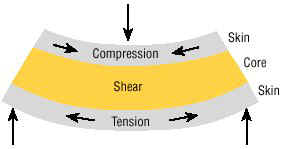
All structural parts of the hull are built as a sandwich of foam core and fibre-reinforced epoxy skins. The reinforcement consists mainly of non-woven glass fabrics. In areas subjected to high loads—such as the beams—the glass reinforcement is replaced by carbon fibre. These modern high-strength fibres also make it possible to replace traditionally used materials such as aluminium and stainless steel for rigging and hardware with lighter and stronger alternatives like carbon and Dyneema.
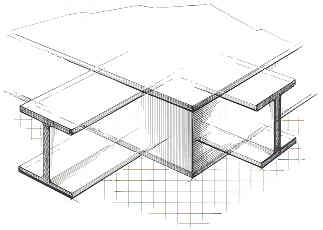
Sandwich construction has been well established in boatbuilding for many decades. Just as a civil engineer uses I-beams in structural design, yacht designers specify sandwich panels for much the same reason: to maximise stiffness while minimising weight.
Engineering theory shows that the flexural stiffness of a panel is proportional to the cube of its thickness. In a sandwich panel, the laminate skins act as the flanges of an I-beam, while the foam core functions as the shear web. The skins are loaded in tension and compression, while the core is loaded in shear. It follows that one of the most critical properties of the core material is its shear strength and shear stiffness.
The core
Core materials include cedar (nature’s honeycomb, but heavy), end-grain balsa (strong, but poor water resistance), honeycombs (expensive and less builder-friendly), foam, and prefabricated combinations of these. Balsa, foam, and honeycombs are most commonly used in rigid moulds by professional series builders.
To use a rigid mould in a one-off boatbuilding project, two additional “boats” must first be built: the plug and the mould taken from it. In series production this is standard practice, as hundreds of boats may be produced from a single mould. For a one-off project, however, this approach is impractical and prohibitively expensive—unless for a sponsored race boat with an unlimited budget. Today, plugs are sometimes made from inexpensive bulk material shaped by CNC milling, but this remains a major undertaking.
Cedar and foam cores make it possible to “construct” a hull using simple male or female frames, without the need for full moulds. By foam, I do not mean the common insulation foams such as polyurethane or polystyrene, which are completely unsuitable for structural applications due to insufficient shear strength. Instead, structural foams include modified (cross-linked PVC), unmodified (linear PVC), and SAN-based foams.
The designer’s specifications are of vital importance, and the chosen core material must comply with the structural calculations and the prescribed building method.
For Fram, I chose Corecell foam—originally produced by ATC Chemicals in Canada and now by SP Systems—as the primary structural core material. Compared to cross-linked PVC foams such as Divinycell, and linear PVC foams such as Airex, this SAN-based foam offers a favourable balance: it is more flexible than cross-linked foams, yet stiffer than linear foams. This makes it particularly well suited to the hull shapes and curvature required by Farrier’s vertical foam stripping method. Corecell combines the strength and toughness of cross-linked foams with the impact resistance and flexibility of linear foams.
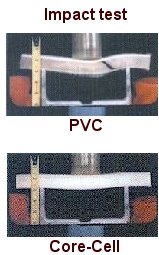
Impact tests show that a sandwich structure with Corecell offers greater resistance to impact forces than comparable cross-linked PVC foams. Corecell is approved by :contentReference[oaicite:0]{index=0}. Another consideration is that with relatively thin laminate skins, PVC foam outgassing can become an issue—something that does not occur with Corecell.
The main disadvantage of Corecell in the Netherlands is its price, approximately 50% higher than other foams. Another drawback is combustibility: it burns fiercely (unlike Divinycell). However, the resin system itself is no better in this respect. Fire prevention on board therefore remains a critical safety concern. In fact, as I see it, fire is the one scenario in which this trimaran could ultimately be lost.
Corecell A500 (80 kg/m³) is used for the hulls and beam bulkheads, while Corecell A1200 (200 kg/m³) is used for high-density inserts for hardware mounting. Corecell T400 is used for interior panels. The standard core thickness is 15 mm.
In series-built boats, the quality of cored hulls can sometimes be compromised by the use of pre-cured, pre-cut foam. While this foam conforms easily to the mould—an advantage in production—it may not be fully impregnated with resin in the foam channels during lamination, potentially leading to serious problems later.
For Fram, the foam core is fully solid and continuous throughout, as it is thermoformed from plain sheets directly on the hull. This eliminates the possibility of air inclusions. In addition, all hulls and structural components are laminated using vacuum infusion, ensuring that even the smallest gaps and drilled holes are completely filled with resin.