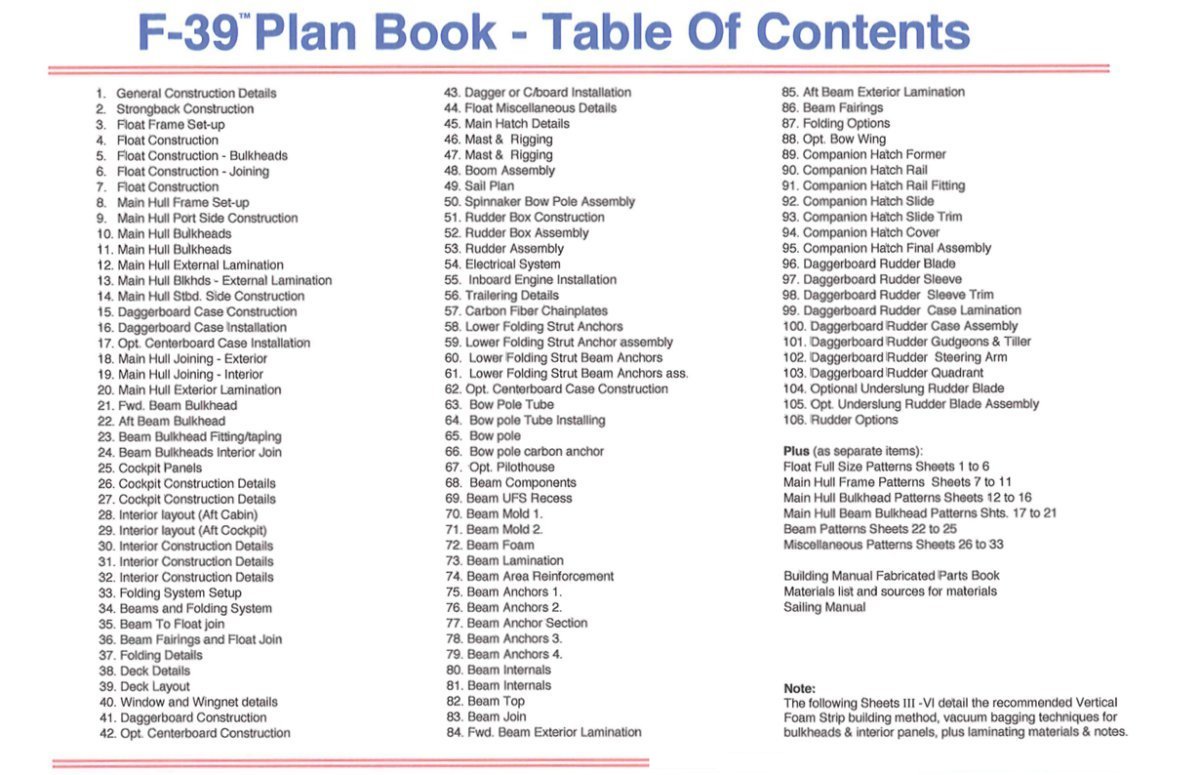
An explanation of why Ian Farrier’s detailed construction plans are essential for successfully building a lightweight and structurally sound trimaran.
Ian Farrier’s Construction Plans
I would never have undertaken a project of this scale without the exceptionally detailed construction plans of world-class designer :contentReference[oaicite:0]{index=0}. Every aspect of the construction is worked out in great detail. By following the instructions precisely—essential when working with composites—the required strength and stiffness are achieved, even when intuition alone offers little guidance.
When working with wood or steel, strength and stiffness can often be judged directly by feel. Composite construction is fundamentally different. The key is to create optimal working conditions, follow the prescribed lay-up schedule, allow proper curing, and trust the result. In my professional career, we achieve this with sand, gravel, steel, cement, and water—reinforced concrete. In this project, the ingredients are foam, fabrics, and epoxy. It is the designer’s “recipe” that ultimately guarantees strength and stiffness.
Achieving a lightweight yet strong result is the primary objective. This requires resisting the natural tendency—common among amateur builders—to make structures heavier in the name of perceived safety. Throughout the build, a checklist-based instruction system keeps the work organised and ensures that each task is completed correctly and as efficiently as possible.
Although the drawings describe the structural aspects of the construction extremely well, specific drawings and details related to the interior—elements that are not directly structural—are largely absent. During the build, however, sufficient know-how is acquired and a solid understanding of structural behaviour develops, making it possible to design and integrate these often time-consuming elements independently.