A detailed explanation of the Farrier construction method, focusing on half-hull building, female moulds, and the vertical foam stripping technique used for the F-39.
Construction method
The key element of the Farrier construction method is the building of half hulls, which are later joined along the centreline.
The centre hull, cabin sides, roof, and most of the deck can be combined and built at the same time. Many interior panels can already be installed before the hull halves are joined. An overlap joint is required along the centreline, but this is precisely the location where additional glass reinforcement is desirable for stiffness and abrasion resistance. This method is significantly easier and faster than the traditional hull-and-deck joining process.
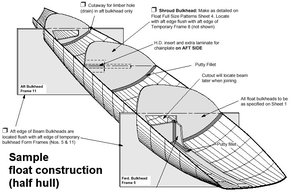
Where conventional one-off yacht construction is still often based on a male mould, :contentReference[oaicite:0]{index=0} uses a female mould to build the hull. One advantage of this method is that all screws are driven from the outside, and stiffening bulkheads can be installed before the hull is removed from the mould. Anyone who has had to climb inside a male mould to remove hundreds of screws will appreciate this. Once removed from the mould, the builder is also not left struggling with a huge, flexible, hard-to-handle “whale”.
Another advantage, which should not be underestimated, is that vacuum laminating in a female mould produces a better laminate with a reduced risk of wrinkles. In a female mould, the fibre stack is compressed into a larger space and experiences tensile stress. In contrast, in a male mould the fibre stack is forced into a smaller space, resulting in compressive stress and an increased risk of fibre wrinkling.
The construction process starts with building the so-called strongback. This is the basic foundation on which the hulls are built. Its purpose is to provide a flat and level reference surface on which the temporary mould frames can be accurately positioned. These temporary frames are made from 18 mm MDF and are spaced at 850 mm intervals.

Traditionally, trimaran hulls were built using narrow longitudinal foam strips, attached to the mould frames and bonded together to form a closed hull shell.
With the introduction of the F-39 design, this construction method was radically changed to the use of wider foam strips, with joints running parallel to the building frames. This is known as the vertical foam stripping method.
Vertical foam stripping
To enable this method, the building frames are connected by fore-and-aft battens, spaced at approximately 100–150 mm, and closer in areas with tighter curvature. To simplify my own work, I widened the frame cut-outs of the hull lines, allowing the battens to be fixed without additional milling of the frames.
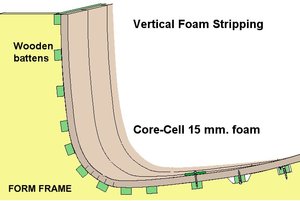
The resulting wooden framework, or female mould, is then planked with foam strips, with the joints running at right angles to the battens. The foam strips must be thermoformed to achieve the required curvature. After some trial and error, I found this is best done using a heat gun and strips with a maximum width of 400 mm. Combined with 300 mm wide strips, this also proved to be the most economical solution, yielding three or four strips from a standard 1220 × 2440 mm (4′×8′) foam sheet.
Self-tapping screws, driven from the outside, temporarily hold the foam strips against the battens. However, the holding strength of screws in foam is limited. A good thermoforming technique is therefore essential to ensure the curved foam strips lie naturally against the battens without residual stress.
Other builders I studied glue the foam strips together immediately during installation. I did not find this practical and therefore developed a different approach, partly to gain better control over achieving an airtight foam hull.
I install the foam strips dry and subsequently widen the joints using a small router, creating a shallow V-shaped groove. These grooves are then filled in three stages with epoxy thickened with microballoons: first a thick mixture, followed by progressively thinner layers. This ensures a strong adhesive bond and perfect airtightness of the joints.
Once the joints have fully cured and are sanded flush, the result is a half foam hull, ready to receive the internal glass laminate. Together with the later-applied external laminate, this forms the sandwich structure that provides the structural basis of the hull.
It was gratifying to see that other builders later adopted this method as well.