A description of the process of assembling two half hulls into a single boat hull, including alignment, bonding, and vacuum-infused exterior lamination.
Assembling two half hulls into a boat hull
Once the internal glassing is complete, all internal stiffeners and bulkheads are installed. The bulkheads are placed onto a bed of wet resin putty and then glass-taped to the hull, wet-on-wet, ensuring optimal bonding without the need for extensive sanding. The hull half is then removed from the mould frames and turned over to laminate the outer skin. The procedure is identical to that used for the internal laminate. For the second hull half, the form frames are reversed and the same process is repeated.
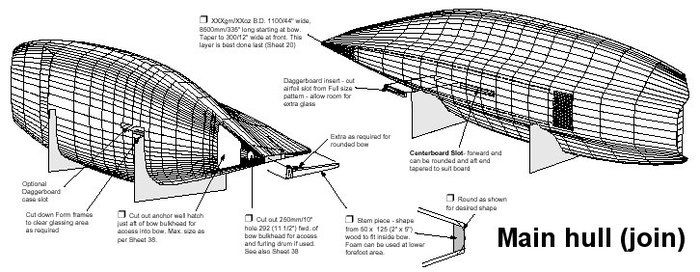
After completion, the two hull halves are joined together using epoxy adhesive, followed by glass taping along the centreline on both the inside and outside.
Up to this point, the assembly method follows the recommendations of :contentReference[oaicite:0]{index=0}. This was one of the stages that caused me many sleepless nights during the preparation phase: how do you align two large hull halves with sufficient accuracy? Fortunately, in practice this proved to be far simpler than expected, and all hull sections aligned perfectly without issues.
I did, however, execute this stage slightly differently, enabled by my use of vacuum infusion. In short, instead of laminating the exterior of each half hull first, I postponed this step until both halves were fully assembled. This made it possible to infuse the exterior laminate of the complete hull in a single resin shot.
At this stage, the bare hulls are finished. In reality, however, hull construction accounts for only about ten percent of the total build time. What follows is the construction of all other structures: the interior, beams, daggerboard, rudder, hardware, engine installation, and the assembly of hulls and beams into a complete trimaran—followed by, without question, the least enjoyable task of all: the fairing, sanding, and painting process.